

Share this
by Minnesota Milk Producers Association on Aug 20, 2026, 9:41:26 AM
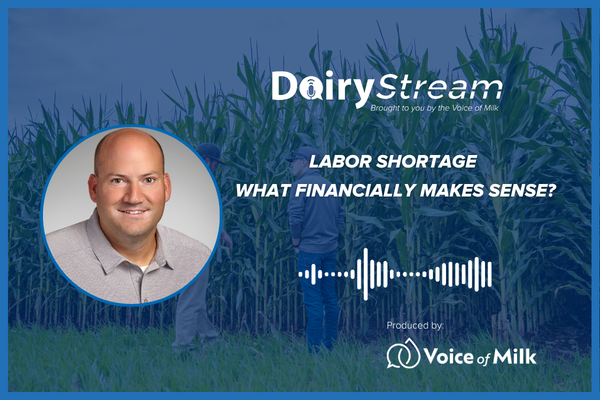
Labor has always been one of the highest costs on a dairy farm, second only to feed for most operations. With ongoing labor shortages and rising wage pressures, dairy producers are being forced to take a closer look at how labor is managed and where efficiencies can be gained.
In a recent Dairy Stream episode, Brad Herkenoff, Senior Dairy Lending Specialist at Compeer Financial, shared insights into labor costs, hidden inefficiencies, automation opportunities and what the future of dairy labor may look like.
The biggest labor drains on dairy farms
According to Herkenoff, routine milking remains one of the most labor-intensive areas on the farm.
"Milking itself is necessary, but it can also expose inefficiencies," he explained. Poor cow flow, outdated parlors, inconsistent procedures and excessive prep times can all increase labor requirements.
Another major labor demand is calf care. While producers may not always realize how much time is spent caring for calves, studies suggest nearly 14% of total farm labor can be dedicated to calf-related tasks. Mixing milk replacer, cleaning equipment, bedding facilities, monitoring health and treating sick animals all require significant employee time.
Employee turnover rounds out the list of major labor drains.
"The cost of replacing a worker can easily reach $15,000 to $20,000 or more," Herkenoff said. "By the time you recruit, train and get someone fully productive, the expenses add up quickly."
The hidden costs of labor
Many labor costs never appear directly on a paycheck.
One of the biggest hidden costs is turnover. Herkenoff cited industry estimates showing dairy farms experience an annual turnover rate approaching 39%. For a farm with ten employees, that means as many as four workers may leave each year.
Beyond recruiting expenses, turnover creates several ripple effects:
- Reduced productivity during onboarding
- Increased training demands on experienced employees
- Lower employee morale
- Greater risk of management oversight gaps
- Potential declines in animal health and milk production
New employees often require three to six months before reaching full productivity. During that transition period, other team members must spend valuable time training rather than focusing on their own responsibilities.
Even small disruptions can impact milk production. Missed health concerns, delayed treatment protocols or inconsistencies in calf care can reduce performance and profitability.
What should labor cost per hundredweight look like?
One common benchmarking question is labor cost per hundredweight (cwt) of milk produced.
While the answer varies significantly depending on farm size, management style, milk production levels, repair responsibilities and whether heifers are raised on-site, Herkenoff provided some general benchmarks:
- $2.50-$3.50 per cwt: Typical healthy range
- Around $4.50 per cwt or higher: Often seen on labor-intensive operations
- Under $2.00 per cwt: Top-tier labor efficiency
"It's important to understand why your labor costs are where they are," said Herkenoff. "Higher costs don't necessarily mean poor performance. The key is knowing what drives the number."
Conducting a labor audit
For producers looking to improve efficiency, Herkenoff recommends starting with a labor audit.
A labor audit examines:
- Daily workflows
- Employee responsibilities
- Time spent on various tasks
- Labor costs relative to milk production
- Staffing levels in key areas
- Opportunities for automation
The goal is to identify bottlenecks and determine whether labor resources are aligned with the farm's needs.
Questions producers should ask include:
- How efficiently are cows moving through the parlor?
- Are calf care procedures optimized?
- Is staffing aligned with workload demands?
- Are certain tasks consuming more time than expected?
Understanding where labor hours are spent is often the first step toward meaningful improvement.
Where automation delivers the best return
Automation continues to reshape dairy operations, especially as labor becomes more difficult to find and retain.
Common technologies include:
- Robotic milkers
- Automated calf feeders
- Feed pushers
- Herd monitoring systems
- Smart collars and ear tags
- Automatic manure scrapers
- Sort gates
While all automation solutions require investment, some offer faster returns than others.
Automated feed pushers
Herkenoff identifies feed pushers as one of the strongest return-on-investment opportunities available today.
By keeping feed consistently available throughout the day, farms often see increased dry matter intake and higher milk production.
Potential benefits include:
- Increased milk production by 2 to 3 pounds per cow daily
- Reduced labor requirements
- Low installation costs
- Payback periods often between one and two years
Automated calf feeders
Automated calf feeders can dramatically reduce labor needs.
Research cited by Herkenoff showed that traditional feeding methods require approximately 7.7 minutes per calf daily, compared to about one minute per calf when using automated systems.
However, facility requirements often determine whether these systems make financial sense.
"If producers need to build a new calf facility to accommodate the feeders, that can quickly change the return on investment," he noted.
Automatic manure scrapers
Manure scrapers provide another labor-saving option. In addition to reducing cleaning requirements, cleaner alleys often result in cleaner udders, reducing prep time in the parlor and improving overall efficiency.
Labor vs. technology: A balance sheet decision
As farms evaluate labor challenges, many are asking whether investments should shift from wages to automation. Herkenoff emphasizes that there is no universal answer.
Labor appears on the income statement as an operating expense, while automation investments appear on the balance sheet as capital expenditures and are depreciated over time.
Before making technology investments, producers should ask:
- Is labor readily available?
- What is employee turnover like?
- What is the expected return on investment?
- What maintenance costs will technology require?
- Does the investment align with long-term farm goals?
The right decision often depends on local labor conditions and the farm's growth strategy.
Employee housing: A retention strategy worth considering
An increasing number of dairy farms are providing employee housing as a retention tool. Herkenoff shared an example of a Wisconsin dairy that reduced turnover from 7% to just 1% after implementing employee housing.
Benefits may include:
- Improved employee retention
- Easier recruitment
- Reduced absenteeism
- Greater workforce stability
Of course, housing also comes with costs, including:
- Property acquisition or construction
- Maintenance
- Utilities
- Insurance
- Property taxes
Still, for many operations, reduced turnover may justify the investment.
Incentive programs that actually work
Not all incentive programs deliver results, but the most successful systems share three characteristics:
- Measurable
- Transparent
- Directly tied to farm goals
Examples include:
Reproductive performance bonuses
Providing bonuses for confirmed pregnancies above a baseline target can encourage greater attention to heat detection and breeding accuracy.
Milk quality incentives
Many dairies share a portion of milk quality premiums with employees when somatic cell counts remain below established thresholds.
Calf health bonuses
Rewarding calf survival and health metrics can encourage stronger attention to newborn care and disease prevention.
Attendance bonuses
Simple attendance and punctuality programs often improve reliability while being easy to track and administer.
Herkenoff stressed that incentive programs should supplement, not replace, competitive base wages.
The most common mistake during farm transition
When farms transition from one generation to the next, labor management is often overlooked.
New leaders frequently inherit existing staffing structures without questioning whether they still fit the farm's goals, size or level of automation.
Herkenoff recommends:
- Conducting a labor audit during transitions
- Clearly defining employee roles
- Communicating expectations early
- Aligning labor strategy with future farm goals
Successful transitions depend on both operational planning and strong employee communication.
What's next for dairy labor?
While labor will always be essential on dairy farms, the nature of that labor is evolving. Herkenoff believes the next major shift will involve increased use of artificial intelligence, predictive analytics, wearable sensors, computer vision systems and automated monitoring technologies.
Instead of spending time searching for health issues in the barn, future employees may spend more time analyzing data and making management decisions.
"I don't think labor is going away," Herkenoff said. "But I do think we'll continue to see employees shift from manual tasks toward managing information and technology."
Final takeaway
Labor remains one of the largest drivers of dairy profitability. Whether through better training, reduced turnover, labor audits, employee incentives, housing programs or strategic automation investments, today's producers have more opportunities than ever to improve efficiency.
The farms that succeed won't simply reduce labor costs. They'll build systems that allow every labor hour to generate more value, productivity and profitability.